
Unsalted Butter in Japan: Why European Butter Holds Exceptional Value
Unsalted butter in Japan is not just a dairy product—it is a high-value, high-demand ingredient that sits at the intersection of culinary precision, scarcity, and premium European identity. For professional buyers, pastry chefs, and specialty importers, sourcing authentic European unsalted butter is less about availability and more about access to the right origins, the right fat profiles, and the right supply structure.
Since 2018, this opportunity has been clear. Conversations with Japanese business leaders consistently pointed to one conclusion: unsalted European butter is one of the most valuable food products that can be exported into Japan. That insight shaped everything that followed. In fact, the idea was so central that BeeBridge almost took a different name entirely—ButterBridge—before expanding into a broader European food export model.
Today, the logic remains unchanged. Unsalted butter is still one of the most strategically important dairy products in Japan.
Why Unsalted Butter Matters in Japan
Japan’s culinary system places extraordinary importance on control, balance, and purity. Unlike salted butter, unsalted butter allows chefs to precisely manage flavor, especially in:
- Pastry and viennoiserie
- High-end baking applications
- Confectionery and desserts
- Fine dining sauces and emulsions
Salted butter introduces variability. Unsalted butter offers consistency and precision, which is why it is the standard in professional kitchens across Japan.
At the same time, domestic butter supply in Japan has historically been restricted and tightly controlled, leading to periodic shortages and high retail prices. This creates a unique market dynamic:
- Strong demand from professionals
- Limited domestic production
- High willingness to pay for imported quality
European butter, particularly from France and select regions across the EU, fills that gap—but only when it is sourced and delivered correctly.
French Unsalted Butter: The Benchmark of Quality
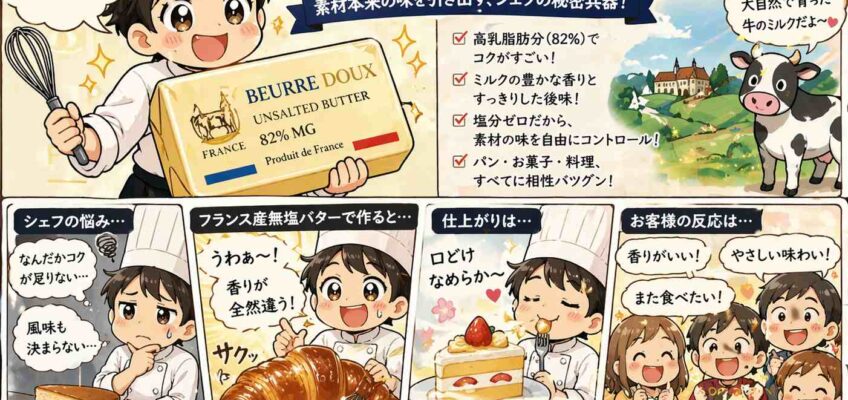
French butter is widely considered the global benchmark, and in Japan, it holds a near-mythical status among pastry chefs and buyers.
What makes French unsalted butter so valuable?
It starts with cream quality and traditional processing. Many French butters are:
- Churned slowly for texture development
- Made from cultured cream (in some cases)
- Produced with strict regional standards (e.g., Normandy, Charentes-Poitou)
The result is a butter with:
- High fat content (82%–84%)
- Smooth, pliable texture
- Deep, layered flavor—even without salt
In Japan, this translates directly into performance. French butter delivers:
- Superior lamination in croissants
- Clean flavor release in pastries
- Consistent emulsification in sauces
For high-end bakeries and patisseries, French unsalted butter is not interchangeable. It is a core ingredient that defines product quality.
Slovenian Butter: The Quiet Luxury
While France dominates perception, Slovenia represents something different—rarity and authenticity.
Slovenian butter is not produced at the same industrial scale. Instead, it comes from smaller dairy systems influenced by:
- Alpine and sub-Alpine grazing
- Diverse floral environments
- Traditional cream handling methods
This creates a butter that is:
- Slightly more variable in character
- Often richer in aroma due to feed diversity
- Perceived as more “natural” and less standardized
In Japan, this plays directly into the premium narrative. Buyers are increasingly looking for products that are not just high quality, but distinct and story-driven.
Slovenian unsalted butter offers:
- A niche positioning in specialty retail
- Strong appeal for artisanal bakeries
- A differentiated alternative to mainstream French supply
It is not a volume product. It is a high-value, limited-availability butter that commands attention in the right market segment.
Swiss Butter: Precision and Purity
Swiss butter sits at the opposite end of the spectrum from Slovenian butter. Where Slovenia offers variation, Switzerland offers control and precision.
Swiss dairy production is known for:
- Strict quality standards
- Highly controlled supply chains
- Consistent feed and animal welfare practices
This results in unsalted butter that is:
- Exceptionally clean in flavor
- Extremely consistent batch to batch
- Structurally reliable for industrial and professional use
In Japan, Swiss butter is valued for its predictability.
For large-scale pastry operations or premium food manufacturing, consistency is critical. Swiss unsalted butter provides:
- Reliable performance in production environments
- Stable texture and melting behavior
- Minimal variation across shipments
It is a butter designed for precision-driven applications, aligning perfectly with Japan’s manufacturing and culinary standards.
The Japanese Market: High Value, High Expectation
What connects French, Slovenian, and Swiss butter in Japan is not just quality—it is market positioning.
Japanese buyers do not treat butter as a commodity at the high end. Instead, they evaluate:
- Origin and terroir
- Fat content and texture
- Production method
- Consistency and reliability
This creates a layered market:
- French butter as the benchmark and prestige product
- Slovenian butter as the rare and differentiated offering
- Swiss butter as the precision and consistency standard
Each has a place, and each can command premium pricing when positioned correctly.
From Insight to Structure: Building the Supply
Since 2018, the objective has been clear: build a system capable of delivering these products into Japan without friction.
The challenge was never demand. It was structure.
European butter producers are fragmented across countries, each with:
- Different export capabilities
- Different minimum order requirements
- Different levels of experience with Japan
At the same time, Japan requires:
- Strict compliance with import standards
- Reliable cold chain logistics
- Consistent supply over time
BeeBridge was built to bridge that gap.
BeeBridge: Making European Butter Work for Japan
BeeBridge operates as a European export layer, connecting multiple butter producers to Japanese buyers through a single structured system.
This means:
- Access to multiple origins (France, Slovenia, Switzerland, and beyond)
- Ability to work with small or large volumes
- Coordination of export documentation and compliance
- Management of cold chain logistics from EU to Japan
Instead of dealing with individual suppliers, buyers connect to a unified supply pipeline.
This is what transforms European butter from an opportunity into a scalable business.
Why Unsalted Butter Remains the Opportunity
Years after that initial insight in 2018, nothing has changed fundamentally.
Unsalted butter in Japan remains:
- High demand due to professional culinary use
- Supply constrained domestically
- Price resilient at the premium level
And European butter—when sourced correctly—continues to meet that demand better than any alternative.
The only difference today is that the pathway is clearer.
Conclusion: The Bridge Between Europe and Japan
Unsalted butter is not just another export product. In Japan, it is a high-value ingredient with cultural, culinary, and commercial significance.
French butter delivers prestige and performance.
Slovenian butter offers rarity and story.
Swiss butter provides precision and consistency.
Together, they represent a complete European butter portfolio capable of serving one of the most demanding markets in the world.
The insight from 2018 still holds: this is one of the most valuable export opportunities in European food.
The name could have been ButterBridge.
Instead, it became BeeBridge—because the opportunity was bigger than butter.
But butter remains at the center of it.