
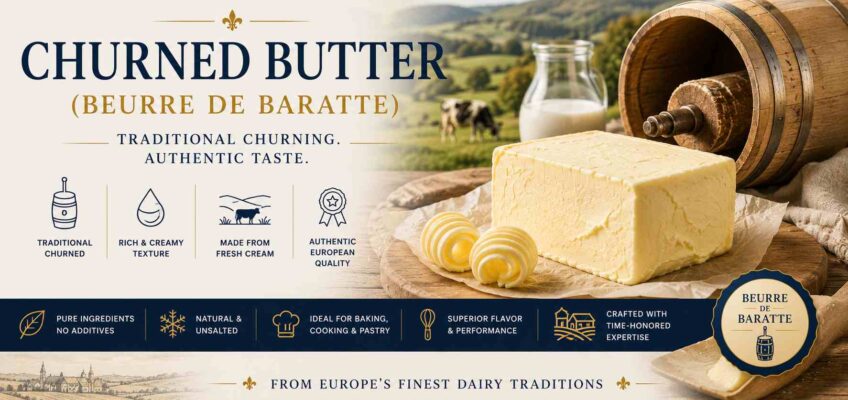
Churned Butter (Beurre de Baratte)
Where Butter Becomes Craftsmanship
Long before stainless steel factories, automated production lines and industrial dairy plants, butter was made one batch at a time. Fresh cream was poured into a wooden churn. The churn turned slowly. Patiently. Hour after hour, the cream gradually separated into butter and buttermilk, producing a texture and flavour that modern continuous production struggles to reproduce. This traditional method became known in France as Beurre de Baratte—churned butter. Today, while most butter in the world is manufactured continuously for efficiency, a small number of European dairies continue to preserve this centuries-old technique. BeeBridge is proud to offer access to producers who still believe that exceptional butter deserves exceptional craftsmanship.

What Is Beurre de Baratte?
Unlike continuous butter production, Beurre de Baratte is produced in traditional churns.
The process is deliberately slower.
The cream is worked more gently.
The butter develops naturally rather than being forced through high-speed industrial equipment.
The result is a butter that many chefs describe as:
- Silkier
- Creamier
- More aromatic
- More complex
- Better balanced
- Richer in texture
It is not simply nostalgia.
The method genuinely influences the finished butter.
Why Does Churning Matter?
Butter is more than butterfat.
Its texture depends on millions of microscopic fat crystals formed during production.
Traditional churning creates a different crystal structure from continuous industrial manufacturing.
This influences:
- Spreadability
- Mouthfeel
- Creaminess
- Water distribution
- Aroma release
- Melting behaviour
These differences become especially noticeable when the butter is enjoyed on its own.
The Butter You Actually Taste
Many ingredients disappear into a recipe.
Beurre de Baratte does not.
It is chosen specifically because people will taste it.
Fresh bread.
Warm baguettes.
Steamed potatoes.
Simple pasta.
Fresh vegetables.
Grilled fish.
The butter becomes part of the experience rather than simply another ingredient.
A Favourite of French Gastronomy
For generations, Beurre de Baratte has occupied a special place in French cuisine.
Many artisan cheesemongers sell churned butter alongside their finest cheeses.
Luxury hotels proudly serve it at breakfast.
Michelin-starred restaurants finish dishes with it rather than ordinary butter.
The reason is simple.
When butter is this good, it deserves to be noticed.
The Perfect Companion for Bread
Perhaps nowhere is churned butter more appreciated than on fresh bread.
A warm baguette.
Country sourdough.
Brioche.
Pain de campagne.
Salted or unsalted, the butter melts slowly, releasing aromas that ordinary industrial butter often lacks.
Sometimes the finest breakfast is simply:
Fresh bread.
Exceptional butter.
Nothing else.
Professional Culinary Applications
Although Beurre de Baratte is wonderful at the table, it also excels in professional kitchens.
Ideal for:
Breakfast Service
Luxury hotels often present churned butter as part of their premium breakfast offering.
Bread Service
Served with artisan bread before the first course.
A simple gesture that immediately communicates quality.
Butter Boards
One of the newest restaurant trends.
Beautiful churned butter becomes the centrepiece rather than a side dish.
Seafood
Scallops.
Lobster.
Crab.
Langoustines.
The gentle richness complements delicate seafood beautifully.
Steaks
A slice of premium churned butter melting over grilled beef remains one of the great pleasures of European cuisine.
Sauces
Because the butter itself possesses greater complexity, classic French sauces become noticeably richer.
Churned Butter and Cultured Butter
The two are often confused.
They are not the same.
Cultured Butter refers to how the cream is prepared before churning.
Beurre de Baratte refers to how the butter is churned after the cream has matured—or even when it has not.
Some of Europe’s finest butters combine both traditions:
- Cream maturation
- Traditional baratte churning
This combination produces extraordinary butter that is exceptionally rare outside Europe.
BeeBridge’s Churned Butter Collection
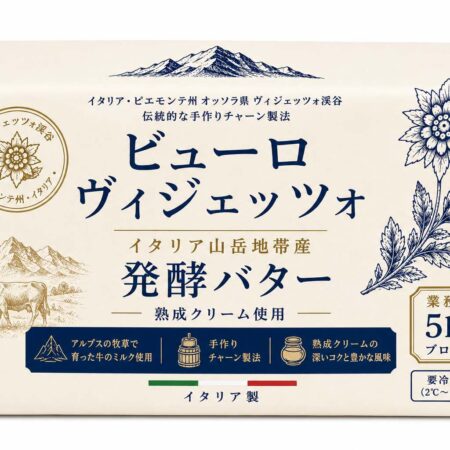
BeeBridge continues to expand its portfolio of traditional butter makers who preserve authentic European butter-making methods.
Our collection includes artisan producers specialising in:
- Traditional Beurre de Baratte
- Organic churned butter
- Grass-fed butter
- Mountain butter
- Cultured churned butter
- Premium retail butter
- Foodservice formats
Every producer has been selected not because they are large, but because they offer something genuinely distinctive.
Why Traditional Butter Still Matters
Industrial butter is designed for efficiency.
Traditional churned butter is designed for flavour.
It takes longer.
It costs more to produce.
It requires experience that cannot easily be automated.
That is precisely why chefs continue to seek it out.
In an industry driven by speed, Beurre de Baratte remains proudly slow.
Discover One of Europe’s Finest Butter Traditions
Beurre de Baratte is not simply another style of butter.
It represents centuries of European dairy craftsmanship, where patience, technique and respect for the cream produce something that modern manufacturing still struggles to imitate.
For importers, luxury retailers, hotels and professional chefs, it offers an opportunity to introduce customers to one of the most authentic expressions of European butter-making.
At BeeBridge, we believe great butter should have a story.
Beurre de Baratte has been telling that story for generations.